JUSTICE DENIED

This is our case... but it can just as easily be yours

A false court claim. A judge who failed to record the trial. Civil restraint for bringing 'fraud' to the court's attention.


This is the case the system tried to close.

Most people never expect to find themselves in court — neither did we!
What protection does the 'average person' have when something goes wrong with the "justice" system?


We are Justice Denied!

One case has exposed serious “legal loopholes” within the civil justice system, allowing a claim for a “false debt” — which was never owed — to stand.

The safeguards built into the UK justice system exist to protect us all, but this case raises fundamental questions as to what happens when the "safeguards" fail.

Exhibit A — The False Claim

A 'false debt ' we never owed

During the Covid lockdown, a UK company took us — a husband and wife — to court, claiming we owed more than £10,000 on an unpaid debt.

There was no contract. The whole case rested on a "made-up" invoice and a "hearsay" witness statement by a company employee. No one from the company turned up to the trial — not the employee, not the company owner.

The trial was held remotely over Zoom, by 'order' of the judge.

With no contract, a single invoice dated seven years 'after' the debt was allegedly incurred, and no supporting financial records, the judge ruled in the company's favour.
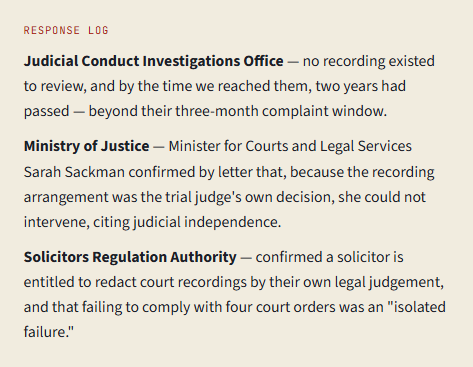
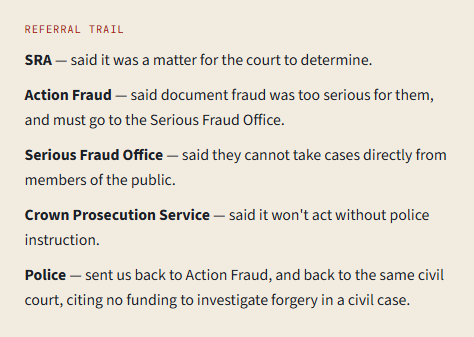
Exhibit B — The Judge's Misconduct

The bundle the judge wasn't permitted to open — but did!

At the start of the trial, the judge opened a bundle of documents marked "without prejudice" — material which courts call the "booby-trap" bundle, banned from a judge's eyes because it can bias their mind in favour of one side.

He confirmed the solicitor had sent it to him by email the day before, that he'd already opened it and read it, then stopped once he saw the label. Then, out loud, he stated:

" It says ‘without prejudice’ and I’m going to read it again. I risk contaminating my mind further, but I will if you want me to Mr....." [the conversation is directed to the company’s lawyer] "The trial judge, moments before opening the bundle

He read the entire bundle. Afterward, he said, again out loud:

"I don't think I should have read it."The trial judge, after reading it

Exhibit C — The Misconduct of the Justice System

The court trial which the judge failed to record

An appeal requires a transcript of the trial, made from the court's own recording. That came at a significant cost to us. But, at this point, we discovered the trial judge had never recorded the trial.

Instead, he'd ordered the company's solicitor to record it, and submit the recording to the court five days after trial. The solicitor failed to submit it for almost two years, despite four further court orders.

When the recording finally arrived, the exact part where the judge read the ‘without prejudice’ bundle and spoke of it ‘contaminating’ his mind — had been deleted. The appeal judge could not access it because of the deletion.

Our appeal was refused, with the appeal judge concluding:

"You have now come to the end of your road."The Appeal Judge, at the end of the appeal

We took the issue to the Judicial Conduct Investigations Office (JCIO) and the Ministry of Justice, but both denied their responsibilities. The solicitor was reported to the Solicitor's Regulation Authority (SRA) — but they took 'no action':

"It seems to me that it was probably correct [for the solicitor] to redact conversations which were about without prejudice issues if the transcript was intended to be used in any appeal... that was a matter of legal judgment by the lawyer with conduct of the matter."The Solicitor's Regulation Authority

And, regarding the solicitor's non-compliance with four court orders:

"An isolated failure to comply with a court order does not automatically result in regulatory action."The Solicitor's Regulation Authority

The court trial which the judge failed to record
Exhibit D — The Forgery

The document the Claimant Company Owner denied writing

During trial, the Claimant Company’s solicitor had submitted a ‘letter’ in evidence which he confirmed, had been written directly to him by the company owner, stating we owed the debt, and it remained outstanding. Although dated four months earlier, the 'letter' had 'never' been disclosed to us or the court, and 'only' appeared for the first time, at trial.

< p>The judge relied heavily on the 'letter' to make his judgment against us.

After trial, We later traced the company owner overseas and showed him the 'letter'. He told us plainly he had never written it, we owed ‘nothing’ to his company, and he had never taken us to court.

After making his own enquiries, he discovered an employee at his company had obtained old financial records from a Charitable Trust he was a Chair of a decade earlier. The Trust had lent us money, which we repaid in full shortly after. Those old Trust records had then been used by the company employee to pursue a claim against us for money we "never owed".

His company had since gone into liquidation, so he wrote to the liquidator to explain the situation — yet was ignored. We wrote too, and were ignored as well.

The document the Claimant Company Owner denied writing
Exhibit E — Silenced by the System

Warned into silence!

We took the forgery back to the same court. Rather than examine it as the court should, the judge issued us with a strict warning: the case was closed, and if we raised the forgery again, he would impose a: Civil Restraint Order against us!

A CRO would restrict us from reapproaching the courts with the forgery . Breaching such an order could result in up to four months in prison.

Our right to be heard was eroded by the very "system" meant to protect us.

We're still fighting to overturn this 'miscarriage of justice' — and to protect the rights of 'all those' who come after us!

What we’ve uncovered through our own case raises serious concerns about the safeguards, procedures and accountability of judges, which are supposed to apply to all cases. It is a test of whether the justice system is capable of holding itself to account for the “miscarriage of justice” it has created and allowed to continue. We believe it should — because 'truth' and 'justice' are what this system is supposed to stand for.

How you can help

Because together we can make the system work better